Paranoid personality
The Caine MutinyParanoid personality becomes a crucial but inconclusive concept in the court-martial of Steve Maryk. The experts identify paranoid features in Philip Francis Queeg, yet their testimony separates a personality description from a disabling illness and from the specific question of fitness to command. That distinction keeps the trial from turning a label into a simple verdict: the issue is not only what Queeg’s personality may be, but whether his condition prevented him from exercising command when the safety of the ship was at stake.
Clinical label and its limits
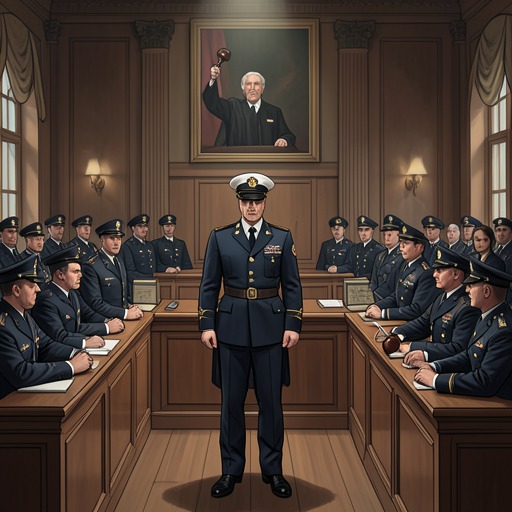
Dr. Forrest Lundeen, chief of psychiatry at the Navy hospital and head of the U.S. Navy Medical Board that examined Queeg, tells the court that the examination involved three weeks of continuous observation and testing. Under questioning by Barney Greenwald, Lundeen acknowledges a cluster of reported behaviors: rigidity, feelings of persecution, unreasonable suspicion, withdrawal from reality, perfectionist anxiety, an unreal basic premise, and obsessive self-righteousness. He characterizes these signs as mild and compensated, rather than as proof of a disease.
Greenwald presses for a single name for the pattern. Lundeen resists treating it as a syndrome because, in his view, there is no disease to establish one; when Greenwald reframes the question, Lundeen identifies a paranoid personality. The exchange makes the label meaningful but carefully bounded. It groups traits into a recognizable pattern without, by itself, establishing that the person is mentally ill or incapable of functioning.
Lundeen describes the decisive threshold in terms of function: a paranoid personality becomes disabling when the person loses control of himself and of the reality around him. Possible reactions might include torpor, frenzy, or nervous collapse, depending on circumstances. The standard therefore turns on impairment, not simply on the presence of suspiciousness or rigidity. A personality feature can be real without constituting a disability; whether it disables someone depends on what happens to judgment and conduct under pressure.
Personality and command fitness
Greenwald sharpens the distinction by asking whether a person might manage subordinate duties while being unfit to command. Lundeen concedes that this is conceivable. The question matters because capacity is role-specific: a trait that does not prevent work as a communications officer might still interfere with the broader demands of a ship captain. The testimony does not make that possibility a finding about Queeg. Lundeen says the medical board did not find him disabled for command.
The dispute turns partly on how difficult such impairment would be to recognize. Lundeen says that a paranoid person may appear extremely plausible and normal on the surface, particularly when justifying himself. The polished appearance does not settle the question either way: it may conceal a serious distortion, but it also means that a diagnosis cannot be inferred simply from an observer’s dislike of a commander’s manner. The trial presents professional assessment as necessary precisely because outward normality and internal difficulty may not align.
Greenwald tests that problem with a hypothetical commanding officer who becomes frightened under fire and runs away, damages government property and denies it, falsifies records, extorts money from subordinates, and imposes excessive punishment for small offenses. These are allegations posed as a hypothetical, not a list Lundeen independently confirms as Queeg’s conduct in this exchange. Lundeen calls the question incomplete and asks whether the officer otherwise performs his duties satisfactorily. Greenwald stipulates that he does, leaving the court with a hard problem rather than an easy diagnostic rule: misconduct, personality traits, and functional performance must be weighed together.
Conflicting psychiatric descriptions
The testimony does not settle on one uncontested formulation. A later medical witness, questioned by Jack Challee, prefers to describe Queeg as having an obsessive personality with paranoid features rather than simply a paranoid personality. The witness also emphasizes that psychiatric terminology is imprecise and that the same term can mean different things even among specialists. In this witness’s view, the phrase paranoid personality sounds more disabling than it necessarily is; the witness, Lundeen, and Dr. Manella all regard Queeg as fit.
This disagreement is not presented as a choice between a diagnosis and no diagnosis. The medical witnesses recognize personality features but differ in the language used to describe them and in what that language implies. The court hears that three psychiatric viewpoints pronounced Queeg fit, while Greenwald’s questioning probes whether fitness for command can depend on the demands and circumstances of the particular post. The result is a separation between naming a pattern and proving a disabling effect.
The storm as a test of capacity
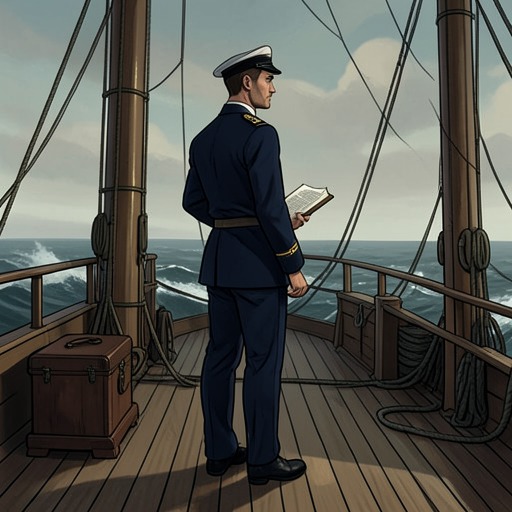
The clinical debate draws its urgency from the typhoon in which Maryk relieved Queeg. Before the crisis, Queeg suspects that warnings may have been mishandled by the radio gang or lost among the ship’s files, even as he is told that the area is clear. Later, when the fleet’s orders call for a southward turn, the ship struggles to hold its course. As the Caine sideslips and broaches, Maryk tells Queeg that the ship must maneuver for its safety and raises the possibility of heading into the wind. Queeg continues to insist on the fleet course of 180.
At the point of relief, the conflict is immediate and procedural as well as personal. Maryk orders the helmsman to steady the ship and tells Willie Keith to note the time; he then informs Queeg that he is temporarily relieving him under Article 184 of the Navy Regulations. The scene gives the command-fitness question concrete stakes: the disputed trait matters because officers must decide what to do while the ship is being driven sideways and the captain persists in an order his executive officer regards as unsafe. The evidence does not make the clinical label itself the cause of the relief; rather, the storm exposes the practical question the label cannot answer on its own.
Significance in the trial
Maryk later tells the court his account of the morning of December 18 and says the ship was in the last extremity when he relieved Queeg. That testimony brings the medical dispute back to the circumstances of the decision. The court must consider not only whether Queeg had paranoid or obsessive features, but whether his behavior and capacity in that particular emergency justified Maryk’s action.
Paranoid personality thus functions as both an explanatory possibility and a limit on explanation. It offers a framework for discussing Queeg’s suspicion, rigidity, self-justification, and response to disagreement, while the experts’ cautions prevent the framework from serving as a verdict by itself. The novel places a clinical vocabulary beside the immediate evidence of command: symptoms are assessed, terminology is contested, and the ultimate question remains what a captain was able to do when the ship needed judgment. The label illuminates the controversy without resolving it.